

After a running session, a CrossFit workout, or a casual football match with friends, the urge for a cold beer is an almost universal reflex. But when you are mindful of your recovery: is alcohol-free beer after exercise a good idea or just a misconception?
The short answer: yes, it is a sound reflex. And there are real scientific reasons behind it.
Alcohol-free beer after exercise — in brief Nearly isotonic, rich in anti-inflammatory polyphenols, 15–35 kcal/100ml (2–3 times less than a regular beer). It supports post-exercise rehydration and provides recovery carbohydrates. Ideal within 30–60 minutes after exercise, served between 4 and 6°C.
What the science says
Polyphenols: natural anti-inflammatories
Beer is naturally rich in polyphenols, antioxidants found in hops and barley malt. A study conducted jointly by the Technische Universität München and Appalachian State University (Dr Johannes Scherr & Prof. David Nieman, Medicine & Science in Sports & Exercise, 2012) on marathon runners showed that those consuming alcohol-free beer had significantly fewer inflammation markers than the control group.
Alcohol-free beer has an osmolality close to that of blood. Your body absorbs it easily and quickly, faster than a plain glass of water. The natural carbohydrates from malt (4–6g/100ml) provide an energy boost without excess, and the minerals (potassium, magnesium, sodium) compensate for losses due to perspiration.
💡 The wine merchant's tip: the right timing is within 30 to 60 minutes after exercise. Not before — your body needs plain water first. Not too long after — beyond 90 minutes, the optimal recovery window closes. A cold alcohol-free beer (4–6°C) in that window is both effective and enjoyable.
The perfect pairing: an alcohol-free beer post-exercise goes well with a recovery snack — banana, nuts, yoghurt. The carbohydrates from the malt and those from the snack complement each other to replenish glycogen stores.
→ Our full selection of alcohol-free craft beers · Sports profile? The Sport selection is made for you.
Not all alcohol-free beers are equal
Check the sugar content
Some industrial 0% beers compensate for the absence of alcohol with excessive sugar (up to 8–10g/100ml). Aim for under 4g/100ml. A study published in Nutrients in 2025 (Kreimeyer et al., PMC12114185) confirms that low-sugar Pilsner-style beers reduce LDL cholesterol, whereas flavoured and sweetened versions cause a rise in blood sugar.
Craft beers rely on hops, not sugar.
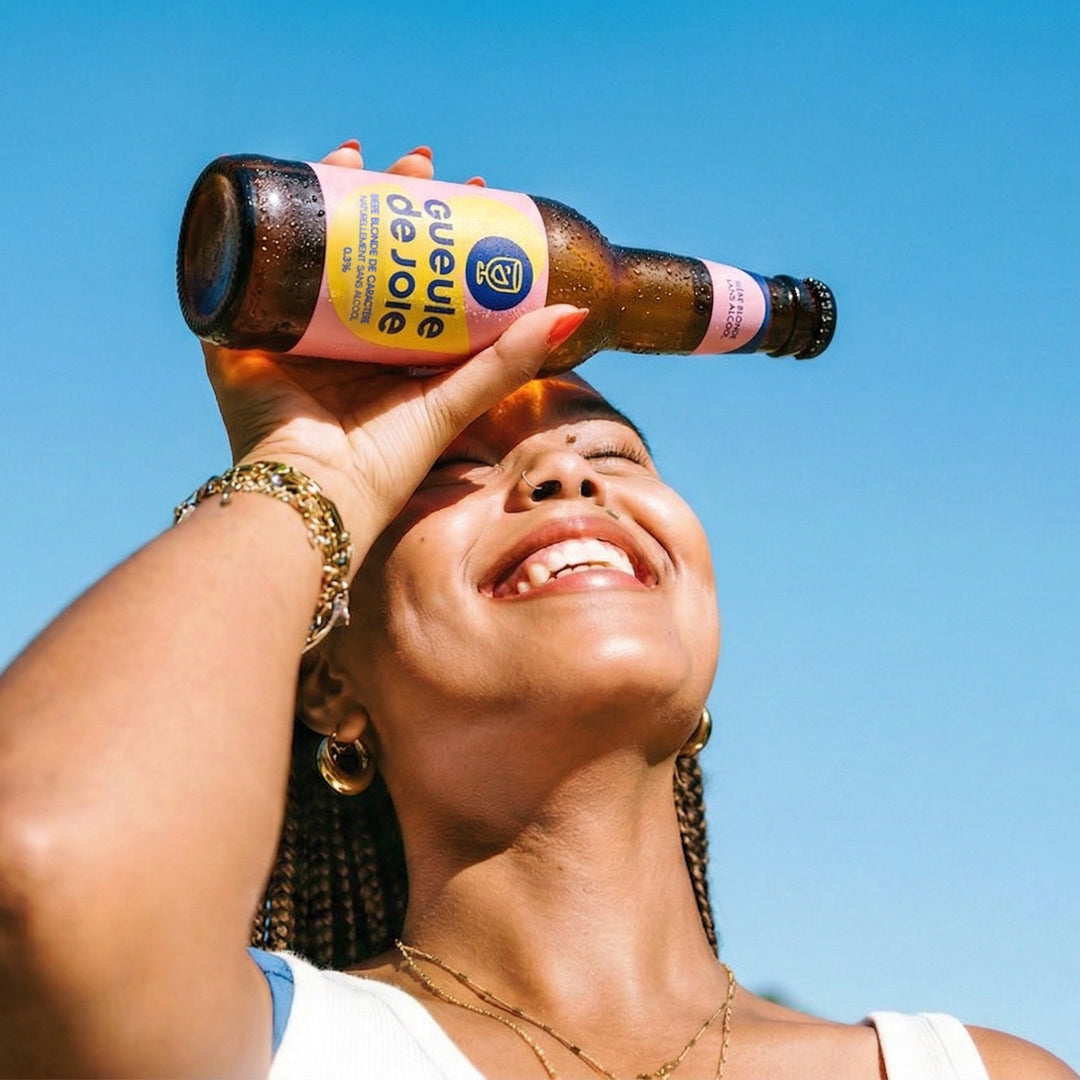
Beers brewed directly at low strength preserve aromas and polyphenols better — that is the method behind the Gueule de Joie manifesto beer, brewed in Belgium at 0.3%.
💡 The wine merchant's tip: choose the right style for your exercise. After intense cardio (running, cycling) → wheat beer or blonde, very refreshing. After a strength session (weight training) → IPA with more body. After a team sport → an accessible blonde for the post-match drink.
The perfect pairing: an alcohol-free IPA after the gym, a wheat beer after a run, a blonde after football. The style of the beer follows the type of exercise — just as you adapt your recovery meal to the intensity of the session.
→ Alcohol-free IPA beers · Low-sugar selection
The Goxoa case: the beer designed for athletes
A brand created by a former high-level triathlete
Goxoa is a French brand whose beers are designed as isotonic recovery drinks, enriched with electrolytes and vitamins.
- Goxoa IPA Sport Beer — isotonic, bitterly fruity, vitamins
- Goxoa Blonde Ale — lemony freshness, light, isotonic
- Goxoa Blanche Citron 0.0% — electrolytes + vitamins, 100% alcohol-free
💡 The wine merchant's tip: the Goxoa Blanche Citron 0.0% is our recommendation for long sessions or competitions. It is designed for recovery, not just for enjoyment — electrolytes, vitamins, zero alcohol. A 33cl can within 30 minutes post-exercise, followed by a litre of water in the hour after.
The perfect pairing: after intense exercise, pair a Goxoa with a complete recovery meal — lean proteins, complex carbohydrates, vegetables. Alcohol-free beer fits into sports nutrition; it does not replace it.
Misconceptions to forget
"That's something for people who don't do sport." It's the opposite. More and more athletes are incorporating alcohol-free beer into their recovery routine.
"It'll make me bloat." 15–35 kcal/100ml and a moderate glycaemic index. Bloating is linked to alcohol, not craft beers.
"You might as well drink water." Water is essential, but alcohol-free beer also provides polyphenols, carbohydrates, minerals — and pleasure.
"They're all the same." No. The gap between a craft beer and an industrial 0% is as wide as the gap between a sourdough loaf and a sliced white bread.
Further reading
- Our manifesto beer: a blonde alcohol-free beer brewed for its 7th anniversary
- Fruity alcohol-free beers: the freshness of summer in a bottle
- The full alcohol-free craft beer selection
Frequently asked questions
Is alcohol-free beer good for recovery?
Yes. Nearly isotonic, anti-inflammatory polyphenols, recovery carbohydrates. Ideal within 30–60 minutes post-exercise. Choose a craft beer with less than 4g of sugar/100ml.
Which beer after a run?
A wheat beer or blonde, very refreshing. The Goxoa Blanche Citron 0.0% is designed for recovery.
Does alcohol-free beer make you put on weight?
No. 15–35 kcal/100ml. Comparable to a kombucha. Bloating is linked to alcohol, not craft beers.
How much should you drink after exercise?
1 to 2 beers (33cl) within 30–60 minutes post-exercise. Supplement with water and a meal.
What is the best alcohol-free beer for athletes?
Goxoa (isotonic, electrolytes). The Gueule de Joie beer is also excellent for its natural character.
Gueule de Joie — France's first alcohol-free wine merchant since 2019. Over 450 references selected for taste, available with 72h delivery across France.
